Lab 3: Practice with MRS
Key Ideas
Class 5 ended with a rule: compare your MRS at bundle \(A\) to the slope of the trade line, and trade when the two differ. The rule was born on Mika’s map, where every curve is smooth and bowed. Today you take it somewhere new.
Meet the maps. Priya counts blue and black pens the same, so \(u = x_1 + x_2\), and her indifference curves are parallel straight lines: one slope, everywhere. Marco’s left and right shoes only help him in pairs, so \(u = \min(x_1, x_2)\), and his curves are L shaped: a flat arm, a vertical arm, and a corner where they meet.
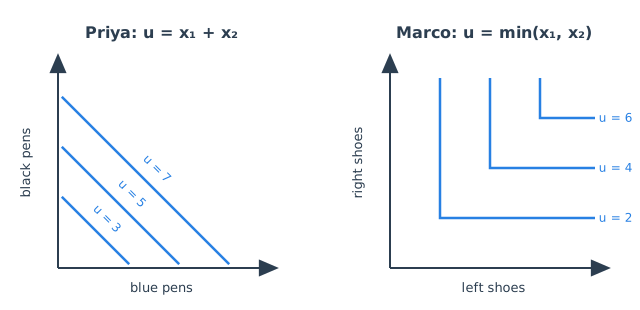
Before trading, remember what the pieces mean. The trade line through \(A\) collects every bundle a post will let you reach, and higher curves are better. Q17 sends Priya and Marco to the trading posts with the Class 5 rule in hand. Watch closely: where does the rule call the trade correctly, where does it go quiet, and where does it never tell you to stop? By the end you will write a rule that works on every map so far.
Problem of the Day
Q17: The Rule Breakers
In Class 5 you built a trading rule for Mika: trade to get the MRS closer to the slope of the trade line, and stop when they become equivalent. But Mika’s indifference curves were smooth and bowed. Today you will stress test the rule on two consumers whose maps are anything but.
Priya has blue pens (\(x_1\)) and black pens (\(x_2\)) with utility \(u = x_1 + x_2\). Marco has left shoes (\(x_1\)) and right shoes (\(x_2\)) with utility \(u = \min(x_1, x_2)\). Both start the day holding the bundle \(A = (6, 2)\). Treat all goods as divisible: Priya can have 3.2 pens and Marco can have 4.6 shoes.
Priya’s friends run three trading posts, each willing to trade in either direction: Post 1 trades 2 black pens per blue pen, Post 2 trades 1 black pen per blue pen, and Post 3 trades 1 black pen per 2 blue pens. For each post, draw Priya’s indifference curve through \(A\) and the trade line through \(A\), and decide whether she should trade, and when should she stop trading? Describe her final bundle at each post.
Now Marco. First mark \(A\) on his indifference map and then find his MRS at point \(A\). A trading post offers him 1 right shoe per left shoe, in either direction. Draw the trade line, decide whether he should trade, and find the exact bundle where he should stop. Then generalize: a post offers \(r\) right shoes per left shoe. Find his stopping bundle as a formula in \(r\), and show that Marco benefits from trading at every rate \(r > 0\), no matter how stingy the post.
Rewrite the class 5 trading rule so that it gives correct advice for Mika, Priya, and Marco all at once.
Solutions
(a) Priya’s indifference curves are straight lines of slope \(-1\), and her utility is the total number of pens. She starts with \(u = 8\).
- Post 1 (2 black per blue). The trade line through \((6, 2)\) has slope \(-2\), steeper than her indifference curve, so part of it climbs above the curve. Each blue pen sold raises her total by 1, and this stays true after every trade because her MRS never changes. She should sell every blue pen and stop at \((0, 14)\) with \(u = 14\). Trading in the other direction lowers her total, so she never buys blues here.
- Post 2 (1:1). The trade line lies exactly on top of her indifference curve. Every reachable bundle gives \(u = 8\), so she is indifferent to trading: nothing to gain, nothing to lose.
- Post 3 (1 black per 2 blue). The profitable direction is giving up black pens: 1 black pen buys 2 blue pens, a net gain of 1 pen per trade. She stops at \((10, 0)\) with \(u = 10\).
The new phenomenon: with straight indifference curves there is no tangency. When trading helps at all, it helps all the way to an axis. These are called corner solutions.
(b) At \((6, 2)\), extra left shoes add nothing (\(MU_1 = 0\)) while an extra right shoe raises the minimum one for one (\(MU_2 = 1\)), so \(MRS = -MU_1/MU_2 = 0\). His indifference curve through \(A\) is L shaped with its kink at \((2, 2)\), and \(A\) sits on the flat arm.
At rate 1: after giving up \(k\) left shoes he holds \((6 - k, \; 2 + k)\), with utility \(\min(6 - k, \; 2 + k)\). This rises until \(6 - k = 2 + k\), so \(k = 2\): he stops at \((4, 4)\) with 4 pairs, doubled from 2. Any further trade destroys pairs.
General rate \(r\): he holds \((6 - k, \; 2 + rk)\) and stops where \(6 - k = 2 + rk\), giving \(k = \frac{4}{1 + r}\). His stopping bundle is on the kink line \(x_2 = x_1\), at \[x_1 = x_2 = 6 - \frac{4}{1 + r},\] which exceeds 2 for every \(r > 0\). So any positive rate helps Marco: surplus left shoes are worthless to him, and even a stingy post converts them into something.
(c) For Priya the rule gets the trade or no trade question right at every post: at Posts 1 and 3 her MRS of \(-1\) differs from the trade line slope and she should trade, while at Post 2 they match and trading is pointless. But the rule can never tell her where to stop, because her MRS is the same at every bundle: the gap between MRS and trade rate never closes, and the answer is a corner rather than a tangency. For Marco the rule starts out fine (\(MRS = 0 \neq -r\), so trade), but at his stopping bundle it goes silent: the MRS is undefined at the kink, where the slope of the indifference curve jumps from \(0\) to infinitely steep. The rule breaks down exactly where the decision is made.
The patched rule is the picture test from Q16, taken seriously as the fundamental version: draw the indifference curve through your current bundle and the trade line through it; trade if some piece of the trade line sits above the curve, and stop at the bundle on the trade line that reaches the highest indifference curve. For smooth bowed curves like Mika’s, that highest point is a tangency and the MRS comparison finds it. For straight curves like Priya’s it is a corner. For kinked curves like Marco’s it is the kink. The MRS equals trade rate condition is a shortcut that works when curves are smooth and bow toward the origin, not the rule itself.