Class 3: Preferences
Optional textbook reading: Varian, Chapter 3, “Preferences.”
Key Ideas
The theory of the consumer is: “the consumer chooses their most preferred bundle out of their budget sets.” Last class we defined the budget set. This class we’ll talk about preferences.
The machinery is deliberately minimal: show a consumer two bundles and ask which they would rather have. Three answers are allowed: the first, the second, or “either one, I’d be equally happy.” That third answer is indifference, and it is not apathy; it means the two bundles genuinely tie.
Rankings alone are enough to produce a picture. Start from any bundle, say 2 tacos and 2 drinks, and hunt down every other bundle that ties with it. Plot them all and connect them: that is an indifference curve. Repeat from other starting bundles and the curves fill the plane, forming an indifference map of your entire taste for tacos and drinks.
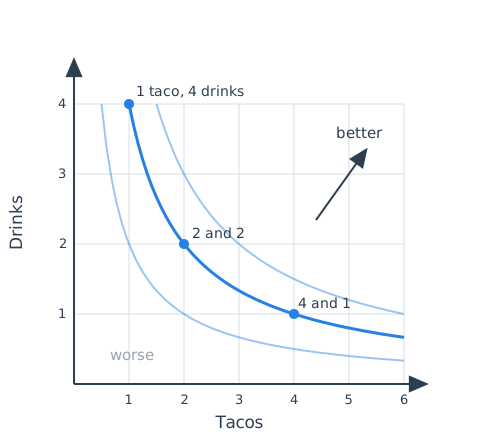
Economists usually assume you can always rank any two bundles, your rankings hang together consistently, and more is better. Today’s problems put those rules under pressure: what must “consistently” mean, and what does violating it cost? What do maps look like for goods you hate, goods that only work in pairs, goods you can have too much of? And how does a curve’s shape decide which trades a person will leap at?
Problems of the Day
Q7: The Poster Trap
Nora collects concert posters. Over coffee she tells you, quite sincerely: “I’d rather have the Beyoncé than the Kendrick. I’d rather have the Kendrick than the SZA. And I’d rather have the SZA than the Beyoncé.” Right now Nora owns the SZA poster, and you happen to own the other two. Nora is always willing to pay a small fee, say $1, to swap the poster she has for one she likes better.
Show that you can collect as much of Nora’s money as you like, and still end the day owning exactly the two posters you started with.
Nora is horrified and wants to repair her preferences so that this can never happen to her again. She is only willing to change one of her three statements. Does it matter which one she changes? State, as precisely as you can, the general rule a person’s preferences must obey to make them safe from this trick.
Extension: You are handed 100 cups of coffee. Cup 1 has no sugar, and each cup has exactly one more grain of sugar than the one before. One grain is far too small to taste, so between any two neighboring cups you are indifferent. Yet cup 100 is noticeably sweet, and you like sweet coffee, so you strictly prefer cup 100 to cup 1. Given these preferences, can someone pump you for money like you did to Nora? Why or why not?
Q8: The Cartographer
A topographic map never labels the elevation of every single point. Instead it draws contour lines through points of equal height, and suddenly the whole landscape is readable at a glance. You can map a person’s tastes the same way: put one good on each axis, pick a bundle, find every other bundle the person likes exactly as much, and draw the curve through them. Repeat for other bundles, and add an arrow showing which direction is “uphill” (toward better bundles).
Draw a preference map, with several contour lines and an uphill arrow, for each of these four customers:
- Priya buys pens, blue ones and black ones. She writes with whatever is in reach and only cares about the total number of pens she owns.
- Marco buys left shoes and right shoes. A left shoe without a matching right shoe is of no use to him at all.
- Dev’s week contains slices of pizza and hours of chores. He likes pizza; chores he would pay to avoid.
- Sana is seasoning a pot of soup, and also stocking up on crackers. More crackers are always better, but for salt she thinks exactly two pinches is perfect: less is bland, more is briny.
For each customer, where on your map does the claim “more of everything is always better” hold, and where does it fail?
On a topographic map, two contour lines for two different elevations can never cross. Explain why not. Now ask the same question of your preference maps: can two contour lines, drawn for one person, ever cross each other?
Q9: Averages and Extremes
Jo and Kai are two days into a hiking trip, and their tastes for food and water are identical. But their packs are not: Jo is carrying 12 granola bars and 1 liter of water, while Kai is carrying 1 granola bar and 12 liters of water.
Economists call an indifference map well-behaved when it obeys two rules. First, more of each good is better, so indifference curves slope downward and bundles up and to the right are on higher curves. Second, averages are at least as good as extremes, so each curve bows in toward the origin. And, as you proved in Q8, two curves on one person’s map can never cross.
At camp the hikers strike a deal: Jo hands over 3 bars for one of Kai’s liters. Both hikers walk away privately convinced they won the trade. Since their tastes are identical, they share a single indifference map. Can you draw one well-behaved map on which each hiker strictly prefers their new pack to their old one? Either draw such a map, plotting all four packs, or argue carefully that no well-behaved map can do it.
Answers
Q7: The Poster Trap.
Nora owns the SZA poster and says she prefers the Kendrick to it, so she pays you $1 to swap: she now holds the Kendrick, and you hold the SZA and the Beyoncé. She prefers the Beyoncé to the Kendrick, so she pays another $1 to swap: she holds the Beyoncé, you hold the SZA and the Kendrick. She prefers the SZA to the Beyoncé, so she pays a third $1 to swap. She is now holding the SZA poster, you are holding the Kendrick and the Beyoncé, and the world is exactly as it was at the start of the day except that you are $3 richer. Every swap was one she asked for. Nothing stops you from going around the loop again, so three dollars a lap, for as many laps as you like. Economists call this a money pump.
It does not matter which statement she changes. Her three statements form a loop: Beyoncé over Kendrick, Kendrick over SZA, SZA over Beyoncé. Reversing any one of the three breaks the loop and leaves a consistent ranking. Reverse the third and she ranks Beyoncé over Kendrick over SZA; reverse the first and she ranks Kendrick over SZA over Beyoncé; reverse the second and she ranks SZA over Beyoncé over Kendrick. In each case there is a top poster, and once she holds it there is no swap she will pay for. The pump cannot return her to where she started because getting back to the starting poster would require preferring a worse poster to a better one.
The general rule is transitivity: if a person considers bundle A at least as good as bundle B, and B at least as good as C, then they must consider A at least as good as C. Equivalently, their strict preferences contain no cycles. Transitivity is what guarantees that any chain of swaps a person is willing to pay for ends, after finitely many steps, at a bundle they rank above the one they started with, so the money they hand over is buying something.
Extension. These coffee preferences violate transitivity, but in a subtler way than Nora’s: the strict preferences are fine (cup 100 over cup 1), and it is the indifferences that fail to chain together. If indifference were transitive, “cup 1 ties cup 2, cup 2 ties cup 3, … , cup 99 ties cup 100” would imply that cup 1 ties cup 100, which it does not.
Can you be pumped? Not in Nora’s way: you will never pay a fee to move from one cup to its neighbor, because you do not prefer the neighbor. But indifference means you are willing to swap for free, and that is enough. Hand you cup 100. Offer cup 99 in exchange, at no charge; you shrug and accept. Offer cup 98; you accept. Ninety-nine free swaps later you are holding cup 1, which you strictly prefer less than cup 100, so now you will pay $1 to swap it for cup 100. Repeat. You lose a dollar a lap, and the only choices you ever made were ones you were, by your own account, happy to make.
The escape is to refuse some of the free swaps, but a person who refuses a swap between cups they call equally good is not really indifferent between them. This is why economists assume that “at least as good as” is transitive, which forces indifference to be transitive too. Preferences that depend on what you can taste, rather than on what is actually in the cup, do not satisfy it.
Q8: The Cartographer. Put the first-named good on the horizontal axis and the second on the vertical axis for each customer.
Priya. She only cares about the total, so a bundle of \(b\) blue pens and \(k\) black pens is exactly as good as any other bundle with \(b + k\) the same. The contour lines are straight lines of slope \(-1\), one for each total, and the uphill arrow points up and to the right. Blue and black pens are perfect substitutes: she will always trade one for one.
Marco. A pair of shoes is worth something; an extra left shoe with no right shoe is worth nothing. His well-being depends on the number of matched pairs, which is the smaller of the two counts. The contour lines are L-shaped, with their corners on the 45-degree line where lefts equal rights, and the uphill arrow runs along that diagonal. Left and right shoes are perfect complements.
Dev. Pizza is a good and chores are a bad. Pile more chores on him and the only way to leave him exactly as happy is to give him more pizza too, so his contour lines slope upward. The uphill arrow points down and to the right: more pizza, fewer chores. Each curve traces out how many slices it takes to compensate him for one more hour of chores.
Sana. Salt on the horizontal axis, crackers on the vertical. At two pinches she needs the fewest crackers to reach any given level of happiness, so every contour line has its lowest point on the vertical line through two pinches and bends upward on either side of it, like a U. To the left of two pinches, more salt is good and the curves slope downward; to the right, more salt is bad and the curves slope upward. The uphill arrow points straight up (more crackers are always welcome) and, horizontally, toward the line of two pinches from either side. The salt axis has a satiation point.
For Priya the claim holds everywhere: more of either pen always lifts her to a higher line. For Marco it depends on what “more of everything” means. More of both goods always lifts him to a higher curve, so the claim holds in that sense. But more of one good alone does nothing: moving along either arm of the L leaves him exactly where he was, so the stronger claim, that more of each good is better, fails everywhere off the diagonal. For Dev the claim fails for chores at every point on the map, and holds for pizza at every point. For Sana it holds everywhere to the left of two pinches and fails everywhere to the right, where more salt is worse, not better. (Crackers behave themselves throughout.)
On a topographic map, each point of ground has exactly one elevation. If the 100-meter contour and the 200-meter contour met at some point, that point would have to be both 100 and 200 meters high, which is absurd.
The same argument works for preferences, with transitivity doing the work that “one elevation per point” does on the mountain. Suppose a contour line through bundle \(X\) and a contour line through bundle \(Y\) cross at some bundle \(Z\). Then \(X\) ties \(Z\) (they are on the same curve) and \(Y\) ties \(Z\) (same reason), so by transitivity \(X\) ties \(Y\). But then \(X\) and \(Y\) are on the same contour line, and what looked like two crossing curves was one curve all along. Two contour lines drawn for two bundles the person actually ranks differently can never cross. Notice that the argument used only transitivity, so it holds for all four maps above, including Dev’s upward-sloping curves and Sana’s U-shaped ones, where “more is better” fails.
Q9: Averages and Extremes. Put granola bars on the horizontal axis and liters of water on the vertical. The four packs are Jo before, \((12, 1)\); Kai before, \((1, 12)\); Jo after, \((9, 2)\); Kai after, \((4, 11)\).
Such a map exists, and almost any well-behaved map will do. The cleanest one to draw is the map whose contour lines are \(\text{bars} \times \text{liters} = \text{constant}\), so that a bundle’s “height” is the product of its two coordinates. Both starting packs sit on the same curve, \(12 \times 1 = 1 \times 12 = 12\), which makes sense: with identical tastes and mirror-image packs, each hiker is exactly as well off as the other. Jo’s new pack is on the curve \(9 \times 2 = 18\) and Kai’s new pack is on the curve \(4 \times 11 = 44\). Both hikers have climbed to a higher curve, Kai by rather more than Jo. The curves of this map slope downward and bow in toward the origin, so it is well-behaved, and the curves \(xy = 12\), \(xy = 18\), and \(xy = 44\) do not cross.
The reason it works is the bow itself. A bowed-in curve is very flat where it meets the horizontal axis and very steep where it meets the vertical axis. At Jo’s starting pack, far out along the horizontal axis, the curve \(xy = 12\) is almost flat: she is drowning in granola and has one liter of water, so she would hand over many bars, about 12 at the margin, for one more liter. Giving up only 3 is a bargain. At Kai’s starting pack the same curve is almost vertical: he would hand over about 12 liters for one more bar, and he is being asked for just 1. Each hiker is surrendering the good they have in excess for the good they are short of, and the bowed-in shape says exactly that a person in an extreme position values the scarce good highly. Both can win, not despite having identical tastes but because the two of them are standing at opposite ends of the same curve.
A map that is not bowed in can break the deal. If the two goods were perfect substitutes, with straight-line contours of slope \(-1\), the hikers would simply count items: Jo falls from 13 to 11 and Kai rises from 13 to 15, so Jo loses and would never agree. The trade is mutually beneficial under convex preferences and not under linear ones, which is the whole content of the “averages are at least as good as extremes” assumption. It is also a preview of the rest of the course: whenever two people start from different points on a shared indifference curve, there is a trade that moves both of them uphill.