Class 7: Demand
Optional textbook reading: Varian, Chapter 6: “Demand.”
Key Ideas
Last class froze the world: prices \(p_1\), \(p_2\) and income \(m\) were fixed, and the consumer picked the best affordable bundle. That choice, written \(x_1(p_1, p_2, m)\), is the demand function. Today we move its moving parts, one at a time, and watch what the consumer does.
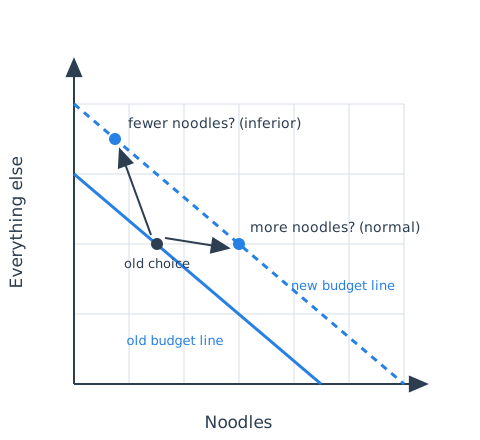
Move income first. A raise shifts the budget line out in parallel and the consumer re-chooses. Buy more of a good when income rises and we call the good normal; buy less and we call it inferior. Connect the chosen bundles as income grows and you trace the income offer curve; plot the chosen quantity against income instead and you have an Engel curve.
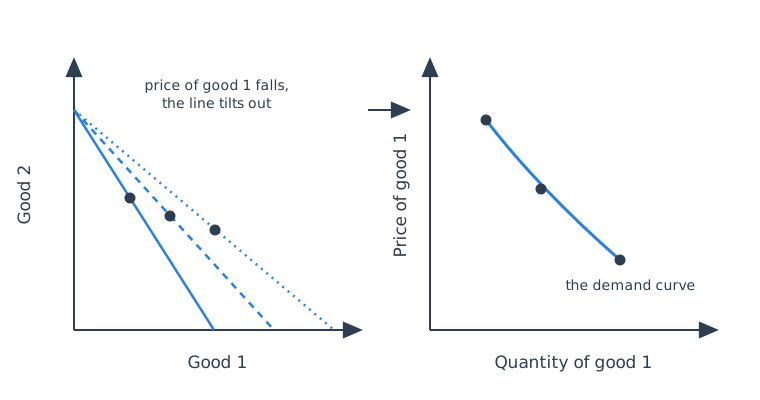
Now move a price instead. Cutting \(p_1\) tilts the budget line outward and the consumer re-chooses again. Plot the chosen quantity of good 1 against its own price and you have drawn the most famous graph in economics: the demand curve. Intuition insists it must slope downward; one of today’s problems asks whether intuition is always right.
Problems of the Day
Q20: The Shape of Wanting
Take Mika (\(u = x_1 x_2\)). Hold the budget \(m\) and \(p_2\) constant, let \(p_1\) change, and calculate the consumer’s choice \(x_1^*\). Plot \(x_1^*\) on the x-axis and \(p_1\) on the y-axis. This is the demand curve.
Q21: The Ungrateful Raise
Tam spends every dollar of her weekly budget on only two things: instant noodles and everything else. After a raise, her roommate watches her unpack the groceries and gasps: “Fewer noodles than last week, and less of everything else too? You bought less of both?” Tam shrugs: “Both are inferior goods for me.” Recall that, for an inferior good, quantity demanded falls when income rises.
Can Tam be telling the truth? Can both goods you purchase be inferior at the same time?
Extension: Could a good be inferior at every income level, from the first dollar up? Think about what that good’s Engel curve would have to look like.
Q22: More Expensive, More Popular
Ren is packing dinners for an 8-day trek: exactly one dinner per day, with $24 to spend. Noodle dinners cost $2 and steak dinners cost $6. Ren loves steak, but a dinner is a dinner. What does Ren pack? Notice you have everything you need to solve this: Ren must purchase 8 dinners, so \(x_n + x_2 = 8\), and among all 8-dinner bundles that are affordable for $24, Ren will choose the bundle with the most steak dinners.
Now a supply shock hits and noodle dinners jump to $3. Work out the new pack. What is unusual about Ren’s demand for noodles? Economists call such a good a Giffen good. Explain in one sentence, to a fellow hiker, why Ren is being perfectly sensible.
Extension: Instead, hold prices at the original $2 and $6 and raise the budget from $24 to $28. What happens to noodle demand? What kind of good, in the language of Q21, must a Giffen good be?
Answers
Q20: The Shape of Wanting. Hold \(m\) and \(p_2\) fixed and solve each consumer’s problem as a function of \(p_1\).
Mika. With \(u = x_1 x_2\) the tangency condition \(x_2 / x_1 = p_1 / p_2\) and the budget line give \(x_1^* = m / (2 p_1)\). She always spends half her money on good 1, whatever its price. Plotted with \(p_1\) on the vertical axis this is a smooth hyperbola: downward sloping, never touching either axis, and flattening out as the price falls.
Q21: The Ungrateful Raise. Tam cannot be telling the truth. Write her two goods as noodles \(x_1\) and everything else \(x_2\). Because she spends every dollar, her bundle satisfies \(p_1 x_1 + p_2 x_2 = m\) both before and after the raise. Suppose both quantities fell. Then the new bundle costs strictly less than the old one, which cost exactly the old income \(m\), so the new bundle costs less than \(m\) and far less than the new, higher income. Tam would be leaving money unspent, which contradicts the premise. Prices did not change, so there is nowhere else for the money to go.
The general rule: when income rises, at least one good must be normal. Inferior goods exist only because some other good is absorbing the extra income. The roommate did not watch Tam buy less of both; one of the two bags was fuller than last week.
Extension. No. At an income of zero Tam buys zero noodles, since she cannot buy anything. If noodles were inferior from the first dollar, demand would have to fall as income rose from zero, which means negative noodles. The Engel curve for an inferior good therefore cannot bend backward from the origin. It must first rise, so that at low incomes the good is normal, and only later turn back. Every inferior good is a normal good somewhere in its Engel curve, at incomes low enough that the consumer cannot yet afford the things they would rather have instead.
Q22: More Expensive, More Popular. Let \(x_n\) be noodle dinners and \(x_s\) steak dinners. Ren needs \(x_n + x_s = 8\), so \(x_n = 8 - x_s\), and the budget constraint \(2 x_n + 6 x_s \le 24\) becomes \(2(8 - x_s) + 6 x_s = 16 + 4 x_s \le 24\), so \(x_s \le 2\). Ren packs 2 steak dinners and 6 noodle dinners, spending exactly $24: eight dinners is the cheapest way to not go hungry, and every dollar left over after guaranteeing that buys an upgrade from noodles to steak at $4 apiece.
Now noodles cost $3. The constraint reads \(3(8 - x_s) + 6 x_s = 24 + 3 x_s \le 24\), so \(x_s \le 0\). Eight noodle dinners alone now cost the entire $24, and there is nothing left to upgrade with. Ren packs 0 steak and 8 noodles. The price of noodles rose from $2 to $3 and the quantity of noodles Ren buys rose from 6 to 8. The demand curve for noodles slopes upward over this range. That is the Giffen case, and it is the counterexample Q20 was waiting for.
To the fellow hiker: “Noodles got more expensive, so I can no longer afford to swap any of them out for steak and still eat every night, so I have to eat noodles every night.”
Extension. Prices back at $2 and $6, budget $28: \(16 + 4 x_s \le 28\) gives \(x_s \le 3\), so Ren packs 3 steaks and 5 noodles. Income rose by $4 and noodle demand fell from 6 to 5. Noodles are an inferior good for Ren, in exactly the sense of Q21: the cheap dinner is what Ren buys to survive, and every extra dollar goes toward replacing it.
That is no coincidence. A rise in the price of noodles makes Ren poorer in real terms, and a poorer Ren buys more of the inferior good. A Giffen good must be an inferior good, and one that takes a large enough share of the budget that being poorer dominates the usual pull toward the cheaper alternative. Next class separates those two forces.