Class 12: Exchange
Optional textbook reading: Varian, Chapter 31: “Exchange.”
Key Ideas
So far one consumer has faced prices that came from nowhere. Today the prices come from somewhere: two people, two goods, and nothing to do but trade.
The Edgeworth box puts a whole economy in one picture. Its width is the island’s total of one good and its height the total of the other, so a single point is an allocation of everything to everyone: read A’s bundle from the lower left corner and B’s from the upper right. Each person’s indifference map is drawn from her own corner, and the starting allocation, the endowment, is just another point in the box.
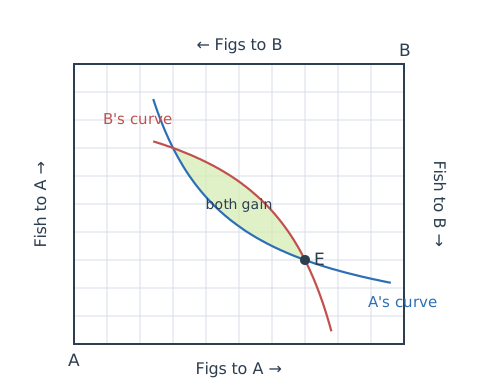
An allocation is Pareto efficient if no reallocation can make one person better off without making the other worse off: there is nothing left to trade. The set of all such allocations is the contract curve. Voluntary trade can move the economy from the endowment toward the contract curve, but the box alone does not say where on it the economy stops.
Prices settle that. Suppose a price ratio is called out and each person, with the value of her own endowment as income, demands her best affordable bundle. If the demands add up to exactly what the island has, the price ratio is a competitive equilibrium; if they do not, the price must move. Today’s problems ask how far bargaining alone can narrow the outcome, and where the market puts it.
Problems of the Day
Q38: The Reluctant Trader
Aria and Bo wash ashore on an island. Aria salvages 8 figs and 2 fish; Bo salvages 2 figs and 8 fish. Each values bundles by \(u = f \cdot c\) (figs times fish). Bo hugs his pile: “I like what I have. Why would I trade?”
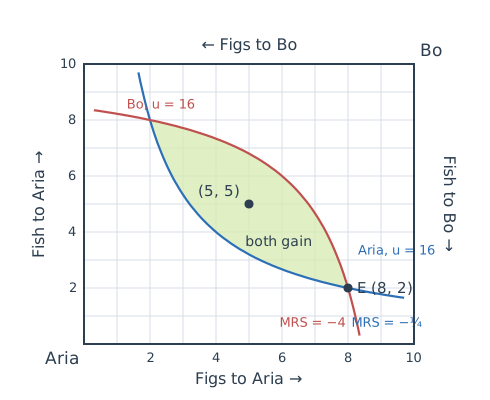
Draw the Edgeworth box for this little economy and mark the endowment. Draw each castaway’s indifference curve through it and compute each castaway’s MRS there. Who is desperate for fish, and who for figs? Shade the set of trades that make both castaways better off. Is swapping 3 figs for 3 fish inside it?
Q39: The Hard Bargain
Bo relents. “Fine. Name a trade. If it leaves me better off than my pile, I’ll take it. But I won’t give a fish more than I have to.” Aria, who once sold used canoes, smiles.
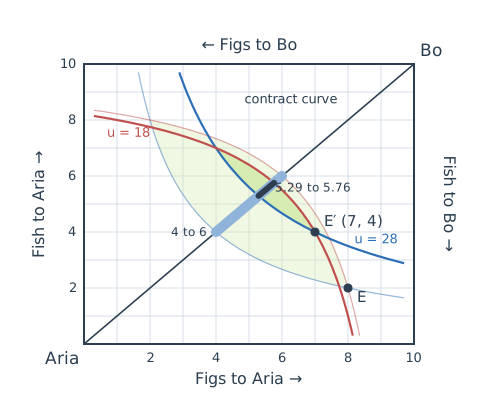
First find every allocation from which no mutually improving trade exists, the contract curve, and describe its shape in one sentence. Then take Aria’s side. Among the trades Bo would accept, which leaves her best off? Find it and compare her utility with her pile and with the 3-for-3 swap. Where would they land if Bo were the shrewd one instead? What does the box say about which of these outcomes will actually happen?
Extension: Suppose Aria warms up with a small trade, one fig for two fish, Bo accepts, and only then does she make her best offer from the new piles. Does the warm-up help or hurt her?
The Second Welfare Theorem. Q39 narrows the outcome to a stretch of the contract curve and then stops: the box cannot say where on that stretch the castaways land. The Second Welfare Theorem says that a market can deliver any point on it. If preferences are convex, every Pareto efficient allocation is a competitive equilibrium for some endowment: move the starting piles to the right place, then let prices do the rest. Which point the economy reaches is a question about where the piles start, not about how the market works. Distribution and efficiency can be settled separately.
Q40: The Amateur Auctioneer
Sick of haggling, Bo proposes a system: he will call out a price, both castaways write down the bundle they want at that price, and trades happen only if the requests add up. Prices are quoted in figs: a fig costs 1, a fish costs \(p\). Endowments and tastes are as in Q38.
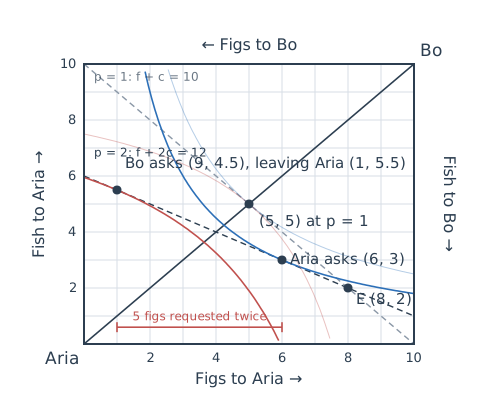
Bo opens with \(p = 2\). Write each castaway’s income and demands and show that the requests do not add up: which good is over-requested, and by how much? Now compute the fig-value of the excess demand for figs plus \(p\) times the excess demand for fish. What do you notice? Then find the price at which both markets clear, the final bundles, and who sells what to whom. Where does the market land on the contract curve from Q39?
The First Welfare Theorem. Every competitive equilibrium allocation is Pareto efficient. Q40 is the theorem in one economy: the auctioneer lands at \((5, 5)\), on the contract curve from Q39, and neither castaway knew the other’s tastes or pile. The argument is the one you have just carried out. At the market-clearing price each castaway chooses a tangency, so Aria’s MRS equals the price ratio and so does Bo’s; their MRSs are therefore equal, which is the condition that defines the contract curve. The general proof is as short. Suppose some feasible allocation made both castaways better off than the equilibrium. Each would have chosen her new bundle at the equilibrium prices had she been able to afford it, so each new bundle must cost more than her income. Adding up, the new allocation costs more than the island’s endowment is worth, and so it cannot be feasible. Prices coordinate without anyone knowing more than her own tastes and her own pile.
Answers
Q38: The Reluctant Trader. The box is 10 figs wide and 10 fish tall. Measure Aria’s bundle from the lower left corner and Bo’s from the upper right; the endowment \(E\) sits at \((8, 2)\) for Aria, which is \((2, 8)\) for Bo. Both castaways have \(u = 16\) at \(E\), so Aria’s indifference curve through \(E\) is \(f c = 16\) drawn from her corner, and Bo’s is \(f c = 16\) drawn from his.
With \(u = f c\), the marginal rate of substitution is \(MRS = -MU_f / MU_c = -c / f\), the slope of the indifference curve; its magnitude is the number of fish a castaway would give up for one more fig. At \(E\), Aria’s MRS is \(-2/8 = -1/4\): she would give only a quarter of a fish for a fig, or, read the other way, four figs for a single fish. Bo’s MRS is \(-8/2 = -4\): he would hand over four fish for one fig. Aria is desperate for fish and Bo for figs. Bo likes what he has only because he has never been offered a fig.
The two indifference curves cross at \(E\) and enclose a lens between them. Every allocation inside the lens gives both castaways more than 16, so every one of them is a trade both would accept. Swapping 3 figs for 3 fish moves Aria to \((5, 5)\) and Bo to \((5, 5)\), each with \(u = 25\): inside the lens, and a good trade for both.
Q39: The Hard Bargain. No improving trade exists exactly where the two indifference curves are tangent, so that the castaways agree on the rate of exchange: \(c_A / f_A = c_B / f_B\). With \(f_B = 10 - f_A\) and \(c_B = 10 - c_A\), this is \(c_A (10 - f_A) = f_A (10 - c_A)\), which simplifies to \(c_A = f_A\). The contract curve is the diagonal of the box from Aria’s corner to Bo’s, the set of allocations in which each castaway holds equal numbers of figs and fish.
Bo accepts any trade that leaves him above \(u_B = 16\). Aria’s best accepted trade must land on the contract curve: from any point off it a lens remains, and a trade inside that lens would make her better off while Bo still said yes. On the diagonal Bo holds \((10 - f_A, 10 - f_A)\) and has \(u_B = (10 - f_A)^2\), which equals 16 at \(f_A = 6\). So Aria’s best offer is two figs for four fish, landing her at \((6, 6)\) with \(u_A = 36\), more than double her pile’s 16 and well above the 25 from the 3-for-3 swap. Bo, at \((4, 4)\), has exactly 16 and is indifferent; Aria must sweeten the offer by a hair to get a yes. If Bo were the shrewd one, the roles reverse: four figs for two fish, Bo at \((6, 6)\) with 36 and Aria at \((4, 4)\) with her original 16.
The box narrows the outcome to the stretch of the diagonal between \((4, 4)\) and \((6, 6)\), the trades both would accept that leave nothing on the table. It cannot narrow further. Which point they reach depends on who bargains harder, and bargaining power is nowhere in the picture.
Extension. After the one-for-two swap Aria holds \((7, 4)\) with \(u_A = 28\) and Bo holds \((3, 6)\) with \(u_B = 18\). Bo’s floor is now 18 rather than 16, so Aria’s best offer lands where \((10 - f_A)^2 = 18\), at \(f_A = 10 - \sqrt{18} \approx 5.76\), and gives her \(u_A \approx 33.2\) instead of 36. The warm-up hurt her. Every trade Bo accepts raises his floor, and the gains she conceded in the first round cannot be recovered in the second. Bo’s floor is the only thing restraining Aria, and a generous opening trade raises it.
Q40: The Amateur Auctioneer. At price \(p\) a castaway’s income is the fig-value of her pile, \(f + p c\), and with \(u = f c\) she spends half on each good: she requests \((f + p c)/2\) figs and \((f + p c)/(2p)\) fish.
At \(p = 2\), Aria’s income is \(8 + 2 \cdot 2 = 12\), so she requests 6 figs and 3 fish. Bo’s income is \(2 + 2 \cdot 8 = 18\), so he requests 9 figs and 4.5 fish. The requests for figs total 15 against 10 on the island: figs are over-requested by 5. The requests for fish total 7.5 against 10: fish are under-requested by 2.5. Now value the excess demands at the going prices: \(1 \cdot 5 + 2 \cdot (-2.5) = 0\). The excess demand for figs is worth exactly as much as the excess supply of fish. That is no coincidence, as the extension shows, and it means Bo only ever has to watch one market.
For figs to clear, \((8 + 2p)/2 + (2 + 8p)/2 = 10\), that is, \(5 + 5p = 10\), so \(p = 1\): one fig per fish. Each castaway then has income 10 and requests \((5, 5)\); \(5 + 5 = 10\) in both goods, so both markets clear. Aria sells 3 figs to Bo for 3 fish. The market lands at \((5, 5)\), squarely in the middle of the stretch of the contract curve that Q39 could not narrow. Nobody bargained, nobody was shrewd, and the price did the whole job.