Class 5: Marginal Utility and MRS
Optional textbook reading: Varian, Chapter 4: “Utility,” the sections on marginal utility and the marginal rate of substitution.
Key Ideas
Last class gave taste a formula. Today we ask it small questions.
First: how much does a little more of one good matter? The marginal utility of good 1, written \(MU_1\), is the rate at which utility rises when you gain a tiny bit more of good 1, holding good 2 fixed; for differentiable functions, it is a partial derivative. Q14 has you compute a few and ask when they shrink as a good piles up.
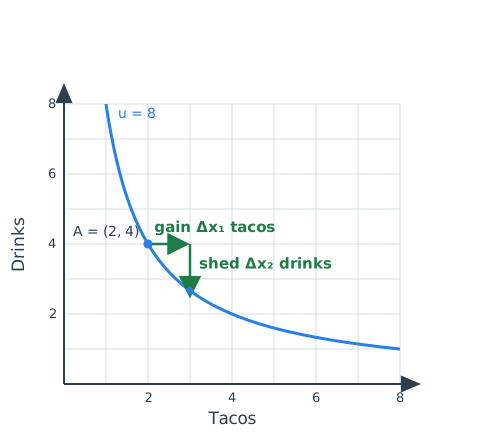
Second: last class also warned us not to trust utility’s units, so try pricing tacos in drinks instead. Start at a bundle, gain a nibble of taco, then shed just enough drinks that you end up exactly as happy. The figure draws the move: two small arrows that trace the indifference curve. The ratio of shed to gain is called the marginal rate of substitution, and Q15 asks what it has to do with \(MU_1\), \(MU_2\), and the slope of the curve.
Third: Q16 hands you a market. Friends offer trades at a fixed rate, so the bundles you can reach form a line through your bundle. Draw the line beside the curve, and let the picture say whether to trade.
Problems of the Day
Q14: Three Appetites
Marginal Utility \(MU_1\) and \(MU_2\) answers the questions: how much will a little more of a good increase your utility? You calculate it using the partial derivative, if the function is differentiable.
Compute \(MU_1\) and \(MU_2\) for each of these three consumers, assuming they are currently holding the bundle (5, 2). Priya has blue and black pens: \(u = x_1 + x_2\). Marco has left and right shoes: \(u = \min(x_1, x_2)\). Mika has tacos and drinks: \(u = x_1 x_2\). Interpret each marginal utility in sentences: “When Priya has 5 blue pens and 2 black pens, an extra blue pen increases her utility by ____ while an extra black pen increases her utility by ____.”
Q15: Proof by Nibble
In this question, you’ll explore the fact that the slope of an indifference curve at a bundle is \(-MU_1/MU_2\). This is called the marginal rate of substitution (MRS).
Finish this proof that the the slope of an indifference curve at a bundle is \(- MU_1/MU_2\).
- We want to show that the slope of the indifference curve (\(\frac{rise}{run} = \frac{-\Delta x_2} {\Delta x_1}\), holding utility constant) is equal to \(- MU_1/MU_2\).
- We know that the definition of marginal utility is the extra utility you get from a little bit more of a certain good: \(MU_1 \equiv \frac{\Delta u_1}{\Delta x_1}\) and \(MU_2 \equiv \frac{\Delta u_2}{\Delta x_2}\)
- Solve for \(\Delta u_1\) and \(\Delta u_2\).
- What’s the last step?
Next, we’ll verify that the slope of an indifference curve can be found using the formula \(- MU_1/MU_2\). Take Priya with her blue and black pens: \(u = x_1 + x_2\). Draw an indifference map with three indifference curves representing all bundles leading to utilities of 1, 2, and 3. Graphically, what is the slope of the indifference curves? Then use the formula \(- MU_1/MU_2\): does this give you the same answer for the slope?
Now we’ll repeat part b for another utility function: take Mika with tacos and drinks with the utility function \(u = x_1 x_2\). Draw an indifference map, estimate the slope at 3 different points along an indifference curve, and then calculate the slope exactly by using the \(- MU_1/MU_2\) formula.
Q16: The Trade Line
Here’s the idea: plot a consumer’s bundle \(A\), draw the indifference curve through it, then draw the trade line: every bundle reachable from \(A\) by trading at the offered rate. Whether to trade is a question about the drawing: does any part of the trade line climb above the indifference curve?
Mika holds A = (2 tacos, 8 drinks) and her friends offer to trade her one drink per taco, in either direction. Draw her indifference curve through \(A\), and then the trade line through \(A\). Can Mika reach a higher utility by trading with her friends?
Instead of trading at a ratio of 1:1, Mika’s friends offer to trade her 2 drinks for 1 taco, in either direction. From A = (2 tacos, 8 drinks), should Mika do any trades?
Instead of trading at a ratio of 1:1, Mika’s friends offer to trade her 4 drinks for 1 taco, in either direction. From A = (2 tacos, 8 drinks), should Mika do any trades? Write down a rule Mika can follow to determine whether or not she should trade. The rule should compare her \(MRS = -MU_1 / MU_2\) at point A to the slope of the trade line.
Answers
Q14: Three Appetites.
- Each marginal utility is a partial derivative, evaluated at \((5, 2)\).
Priya, \(u = x_1 + x_2\): \(MU_1 = 1\) and \(MU_2 = 1\). When Priya has 5 blue pens and 2 black pens, an extra blue pen increases her utility by 1, and an extra black pen increases her utility by 1. The bundle did not matter; a pen is a pen.
Marco, \(u = \min(x_1, x_2)\): at \((5, 2)\) the smaller count is the right shoes, so \(u = 2\) and the formula is behaving like \(u = x_2\) in this region. Hence \(MU_1 = 0\) and \(MU_2 = 1\). When Marco has 5 left shoes and 2 right shoes, an extra left shoe increases his utility by 0, since it has nothing to pair with, while an extra right shoe increases his utility by 1, a whole new pair. (The function is not differentiable on the diagonal \(x_1 = x_2\), where a step in either direction gives a different answer, but \((5, 2)\) is safely off it.)
Mika, \(u = x_1 x_2\): \(MU_1 = x_2 = 2\) and \(MU_2 = x_1 = 5\). When Mika has 5 tacos and 2 drinks, an extra taco increases her utility by 2, while an extra drink increases her utility by 5. Each good’s marginal utility is the amount of the other good: a taco is worth more to her the more drinks she has to go with it.
Q15: Proof by Nibble.
Multiply each definition through by its \(\Delta x\): \(\Delta u_1 = MU_1 \, \Delta x_1\) is the utility gained from the taco nibble, and \(\Delta u_2 = MU_2 \, \Delta x_2\) is the utility lost from the drinks shed. The last step is to use the fact that the move stays on one indifference curve. Staying exactly as happy means the gain and the loss are equal, \(\Delta u_1 = \Delta u_2\), so \[MU_1 \, \Delta x_1 = MU_2 \, \Delta x_2 \quad\Longrightarrow\quad \frac{\Delta x_2}{\Delta x_1} = \frac{MU_1}{MU_2}.\] The shed is downward, so the slope carries a minus sign: \(\text{slope} = -\Delta x_2 / \Delta x_1 = -MU_1 / MU_2\). In words, the curve is steep where good 1 is valuable relative to good 2, because a nibble of it then buys a large shed of good 2.
The curves \(x_1 + x_2 = 1\), \(x_1 + x_2 = 2\), and \(x_1 + x_2 = 3\) are parallel straight lines with slope \(-1\): each runs from \((0, k)\) down to \((k, 0)\). The formula gives \(-MU_1 / MU_2 = -1/1 = -1\) at every bundle. The two agree, and the agreement holds everywhere, which is why Priya’s map is a set of parallel lines: her MRS is the same at every bundle.
Take the curve \(x_1 x_2 = 8\), which passes through \((1, 8)\), \((2, 4)\), and \((4, 2)\). The curve is \(x_2 = 8 / x_1\), and its slope at a point is \(-8 / x_1^2\), so the slopes at those three bundles are \(-8\), \(-2\), and \(-\tfrac{1}{2}\). A careful sketch should give estimates near those numbers: very steep at the left, flattening quickly to the right. The formula gives \(-MU_1 / MU_2 = -x_2 / x_1\), which at the three bundles is \(-8/1 = -8\), \(-4/2 = -2\), and \(-2/4 = -\tfrac{1}{2}\). The match is exact, and it is exact at every bundle, since on the curve \(x_2 = 8/x_1\) the expression \(-x_2/x_1\) is \(-8/x_1^2\).
The numbers also say what the bow means. At \((1, 8)\) Mika is drowning in drinks and short of tacos, so she will shed 8 drinks for one more taco. At \((4, 2)\) the situation is reversed and she will shed only half a drink. The MRS falls in magnitude as tacos pile up, and that falling ratio is the bowed-in shape.
Q16: The Trade Line.
Through \(A = (2, 8)\) runs the curve \(x_1 x_2 = 16\), with slope \(-MU_1 / MU_2 = -8/2 = -4\) at \(A\): Mika would shed four drinks for one more taco and be exactly as happy. Every trade line in this question is compared to that number.
One drink per taco gives the trade line \(x_2 = 10 - x_1\), with slope \(-1\). At \(A\) the line is far flatter than the curve, so just to the right of \(A\) the line sits above the curve. Any small move along it toward more tacos lands on a higher curve: \((3, 7)\) scores 21, \((4, 6)\) scores 24, and \((5, 5)\) scores 25, the best bundle on the line. Yes, she should trade drinks for tacos. The reason is in the slopes: she is willing to give up four drinks for a taco, and her friends only ask for one.
Two drinks per taco gives the line \(x_2 = 12 - 2x_1\), with slope \(-2\). That is steeper than before but still flatter than the curve at \(A\), so the same argument goes through. Moving right, \((3, 6)\) scores 18, which beats 16, and that is in fact the best bundle on this line. Mika should still trade, but only one taco’s worth; by \((4, 4)\) she is back down to 16.
Four drinks per taco gives the line \(x_2 = 16 - 4x_1\), with slope \(-4\), the same as the curve at \(A\). The line is tangent to the curve there, and because the curve bows in, every other point on the line sits below it. Trading right to \((3, 4)\) scores 12; trading left to \((1, 12)\) also scores 12. No trade in either direction helps. Her friends are charging exactly the rate at which she is indifferent, so \(A\) is already the best bundle she can reach.
The rule: compare the magnitude of the MRS at \(A\) to the rate the market charges, both in drinks per taco. If \(|MRS|\) exceeds the market rate, a taco is worth more to Mika than it costs, so she should trade drinks for tacos (the trade line is flatter than the curve, and moving right climbs). If \(|MRS|\) is below the market rate, she should trade tacos for drinks (the trade line is steeper, and moving left climbs). If the two are equal, the line is tangent and she should stay put. In every case she keeps trading until the MRS at her new bundle matches the market rate, which is where the trade line and the indifference curve touch.