Class 1: Math Review
Problems of the Day
Q1: A Chance to Win
You arrive in a room where you are given $128 and six cards (3 red winning cards and 3 black losing cards).
You must choose and lay the cards down, one at a time. You can decide in which order to lay them down.
At each stage you must bet exactly half the money that you have available. If you select and play a black card, you lose the money you bet.
If you select and play a red card, you receive double the money you bet.
If you end up with more money than you started, you get to keep the profit.
What’s the best order for laying down the cards?
Source: @nrich-chance-to-win.
Q2: Surprising Transformations
I took the graph \(y = 4x + 7\) and performed the following transformations:
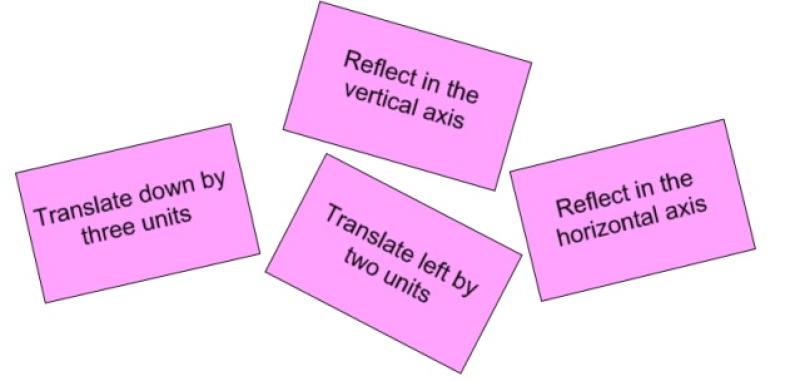
Unfortunately, I can’t remember the order! I only know I ended up with the graph of \(y = 4x - 2\). Can you find the order in which I carried out the transformations?
Source: @nrich-surprising-transformations.
Solutions
Q1: A Chance to Win. The key is to ask what one card does to your money. Suppose you hold \(M\). You must bet \(\tfrac{M}{2}\). If the card is black you lose the bet and are left with \(\tfrac{M}{2}\), so a black card multiplies your money by \(\tfrac{1}{2}\). If the card is red you get the bet back doubled: you keep the \(\tfrac{M}{2}\) you did not bet and receive \(2 \times \tfrac{M}{2} = M\), for a total of \(\tfrac{3M}{2}\). So a red card multiplies your money by \(\tfrac{3}{2}\).
Every card is therefore a multiplication, and multiplication is commutative: the order of the factors does not change the product. Whatever order you choose, you play three reds and three blacks, so you always finish with
\[128 \times \left(\tfrac{3}{2}\right)^3 \times \left(\tfrac{1}{2}\right)^3 = 128 \times \tfrac{27}{8} \times \tfrac{1}{8} = 128 \times \tfrac{27}{64} = 54.\]
There is no best order. Every order leaves you with $54.
Q2: Surprising Transformations. Write the line as \(y = mx + c\) and record what each transformation does to the pair \((m, c)\):
| Transformation | New equation | Effect on \((m, c)\) |
|---|---|---|
| Translate down 3 | \(y = mx + c - 3\) | \(c \to c - 3\) |
| Reflect in the vertical axis | \(y = m(-x) + c\) | \(m \to -m\) |
| Translate left 2 | \(y = m(x + 2) + c\) | \(c \to c + 2m\) |
| Reflect in the horizontal axis | \(y = -(mx + c)\) | \(m \to -m,\; c \to -c\) |
The slope is only ever flipped in sign, and it is flipped twice, so it ends at \(4\) in every order; the slope tells us nothing about the order. The intercept is what carries the information. Two things matter.
First, a reflection in the horizontal axis flips the sign of whatever intercept it finds. If the translation down 3 comes before that reflection, the \(-3\) is turned into \(+3\) and the line ends up higher than it started; if it comes after, the \(-3\) survives. Second, a reflection in the vertical axis reverses the direction of any horizontal shift, and a shift left by 2 on a line of slope \(m\) raises the intercept by \(2m\). If the shift comes before that reflection it acts on slope \(-4\) and lowers the intercept by 8; if it comes after, it acts on slope \(4\) and raises it by 8.
Starting from \(c = 7\) and applying both reflections first, the intercept becomes \(-7\). Then down 3 gives \(-10\), and left 2 on slope \(4\) gives \(-10 + 8 = -2\). That is the target, so the order
\[\text{reflect in vertical axis} \;\to\; \text{reflect in horizontal axis} \;\to\; \text{translate down 3} \;\to\; \text{translate left 2}\]
works. It is not the only one. Any order in which the horizontal reflection precedes the translation down and the vertical reflection precedes the translation left gives \(y = 4x - 2\). There are six such orders out of the 24 possible:
- vertical reflection, horizontal reflection, down 3, left 2
- vertical reflection, horizontal reflection, left 2, down 3
- horizontal reflection, vertical reflection, down 3, left 2
- horizontal reflection, vertical reflection, left 2, down 3
- vertical reflection, left 2, horizontal reflection, down 3
- horizontal reflection, down 3, vertical reflection, left 2
The remaining 18 orders produce only three other lines: \(y = 4x + 4\), \(y = 4x - 12\) and \(y = 4x - 18\). So the question cannot be answered uniquely, but it can be answered structurally: I reflected before I translated, in each direction.
Check Your Understanding
Fractions
Fractions are everywhere in economics: a budget share is a fraction of income, a probability is a fraction of outcomes, and every slope we will meet this quarter is a rise over a run. This section rebuilds the mechanics so they are automatic when we need them.
In the fraction \(\frac{3}{8}\), the bottom number (the denominator) says how many equal parts the whole is cut into, and the top number (the numerator) says how many of those parts you have. A whole number paired with a fraction, like \(1\tfrac{3}{4}\), is a mixed number, which is just another way of writing the single fraction \(\frac{7}{4}\). Finally, multiplying the top and bottom by the same number leaves the value unchanged, which is why \(\frac{2}{3}\) and \(\frac{4}{6}\) are equivalent. That one idea powers almost everything below.
Adding and subtracting. Imagine cleaning up after a party. Three pizza boxes are left: one holds \(\frac{1}{2}\) of a pizza, one \(\frac{1}{8}\), and one \(\frac{3}{4}\). How much pizza do you have in total? You cannot just add the numbers as they stand, because halves, eighths, and quarters are different sized slices. The fix is to cut every pizza into slices of the same size. Eighths work for all three: \(\frac{1}{2} = \frac{4}{8}\), \(\frac{3}{4} = \frac{6}{8}\), and \(\frac{1}{8}\) already is one. Once every slice is the same size, adding is just counting slices:
\[\frac{4}{8} + \frac{1}{8} + \frac{6}{8} = \frac{11}{8} = 1\tfrac{3}{8} \text{ pizzas}\]
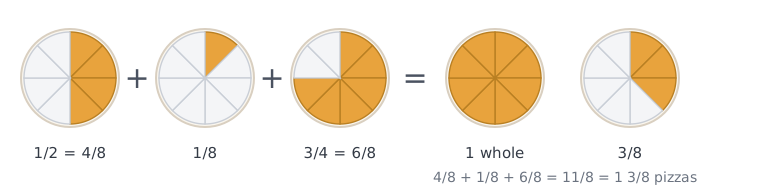
That is all a common denominator is: a slice size that works for every fraction in the sum, so the pieces can be counted together. There are three cases, from easiest to hardest. If the denominators already match, the slices are the same size, so just add the numerators:
\[\frac{1}{5} + \frac{3}{5} = \frac{4}{5}\]
If one denominator is a multiple of the other, rewrite only one fraction:
\[\frac{1}{4} + \frac{3}{8} = \frac{2}{8} + \frac{3}{8} = \frac{5}{8}\]
Otherwise find the least common denominator; when in doubt, the product of the two denominators always works:
\[\frac{3}{5} + \frac{1}{7} = \frac{21}{35} + \frac{5}{35} = \frac{26}{35}\]
Mixed numbers can be handled piece by piece, wholes with wholes and fractions with fractions, but when a subtraction needs borrowing it is safer to convert everything to single fractions first:
\[3\tfrac{1}{6} - 1\tfrac{2}{3} = \frac{19}{6} - \frac{10}{6} = \frac{9}{6} = 1\tfrac{1}{2}\]
Multiplying and dividing. No common denominator needed here. To multiply, go straight across the tops and the bottoms:
\[\frac{2}{3} \times \frac{1}{5} = \frac{2}{15}\]
To divide, multiply by the reciprocal of the second fraction:
\[\frac{1}{2} \div \frac{1}{4} = \frac{1}{2} \times \frac{4}{1} = 2\]
That answer deserves a pause: dividing by a number smaller than 1 makes the result bigger, because you are asking how many quarters fit inside one half. Convert mixed numbers to single fractions before multiplying or dividing:
\[1\tfrac{2}{3} \times 2\tfrac{1}{4} = \frac{5}{3} \times \frac{9}{4} = \frac{45}{12} = 3\tfrac{3}{4}\]
The classic mistake is multiplying the whole parts and the fraction parts separately, which here would give \(2\tfrac{1}{6}\). Tempting, but wrong.
Order of operations. Nothing changes when fractions are involved: parentheses first, then multiplication and division from left to right, then addition and subtraction.
\[\frac{1}{2} + \frac{1}{2} \times \frac{1}{3} = \frac{1}{2} + \frac{1}{6} = \frac{2}{3}\]
Now check yourself:
Exponents
Exponents are how economics handles growth. A dollar invested at 5 percent interest is worth \((1.05)^{10}\) dollars after ten years, and the production functions we will meet later, like \(x^{a}y^{b}\), are built entirely from powers.
An exponent counts multiplications: \(2^3\) means \(2 \cdot 2 \cdot 2 = 8\). It does not mean \(2 \times 3\). Two special cases follow directly. Raising to the power 1 changes nothing, so \(5^1 = 5\), and any nonzero number raised to the power 0 equals 1, so \(5^0 = 1\). One way to see the second: \(\frac{5^3}{5^3} = 5^{3-3} = 5^0\), and a number divided by itself is 1. Also watch parentheses around negatives: \((-3)^2 = (-3)(-3) = 9\), while \(-3^2 = -(3^2) = -9\).
When to add exponents. Multiplying powers of the same base just lines up all the factors, so the exponents add:
\[x^2 \cdot x^3 = (x \cdot x)(x \cdot x \cdot x) = x^5\]
A quick check with numbers: \(2^4 \cdot 2^2 = 16 \times 4 = 64\), which is exactly \(2^6\), and indeed \(4 + 2 = 6\). Dividing removes factors, so the exponents subtract: \(\frac{x^7}{x^3} = x^4\).
When to multiply exponents. A power of a power repeats the whole block, so the exponents multiply:
\[(x^2)^3 = x^2 \cdot x^2 \cdot x^2 = x^6\]
The rule of thumb: multiplying powers adds exponents, while raising a power to a power multiplies them. An outside power also applies to every factor inside the parentheses: \((2x^3)^2 = 4x^6\).
Negative and fractional exponents. A negative exponent means a reciprocal, not a negative answer:
\[2^{-3} = \frac{1}{2^3} = \frac{1}{8}\]
A fractional exponent means a root: \(9^{1/2} = \sqrt{9} = 3\) and \(8^{1/3} = 2\). When the two are combined, take it in steps:
\[4^{-3/2} = \frac{1}{4^{3/2}} = \frac{1}{(\sqrt{4})^3} = \frac{1}{8}\]
Now check yourself:
Logarithms
A logarithm is the inverse of an exponent. An exponent starts with a base and a power and gives you a result. A logarithm runs that backward: it starts with the result and tells you what power the base was raised to. In short, it answers the question “how many times was the base multiplied?” Ex)
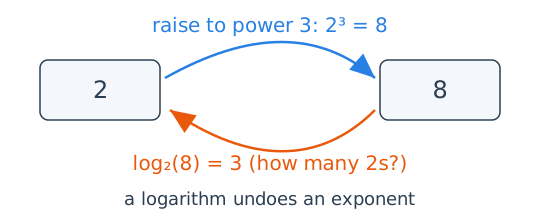
You can always check a logarithm by converting it back to an exponent: \(\log_2 8 = 3\) is just the statement \(2^3 = 8\) read backward. If your answer works as an exponent, it is right.
The product rule turns multiplication inside a logarithm into addition. It says \(\log_b (A \times B) = \log_b A + \log_b B\). Ex)
\(\log_3(3 \times 9) = \log_3 3 + \log_3 9 = 1 + 2 = 3\)
The exponent rule lets you pull a power out to the front of a logarithm. It says \(\log_a B^C = C \log_a B\). Ex)
\(\log_2 8^3 = 3 \log_2 8 = 3 \times 3 = 9\)
Check it: \(8^3 = 512\), and \(2^9 = 512\) as well.
Now check yourself:
Plots
The most common way to write a line is slope-intercept form, \(f(x) = mx + b\). Here \(m\) is the slope, which measures how steep the line is, and \(b\) is the y-intercept, the height of the line where it crosses the vertical axis at \(x = 0\). Ex)
For the line \(f(x) = -x + 4\), the slope is \(-1\) and the y-intercept is \(4\). Read the equation as a recipe: start at the y-intercept \((0, 4)\), and for every step to the right, move down 1, because the slope is \(-1\). That already gives you the points \((1, 3)\) and \((2, 2)\).
Then sketch the line.
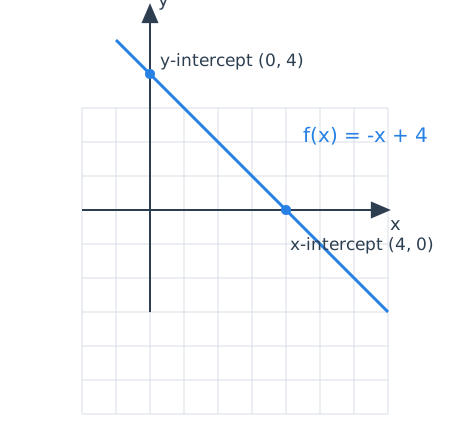
Not every line is written in slope-intercept form. To sketch \(2x + 4y = 8\), find where it crosses each axis. Set \(x = 0\) and solve for \(y\) to get the y-intercept, then set \(y = 0\) and solve for \(x\) to get the x-intercept. Plot those two points and connect them.
For \(2x + 4y = 8\): setting \(x = 0\) gives \(4y = 8\), so \(y = 2\); setting \(y = 0\) gives \(2x = 8\), so \(x = 4\).
Now check yourself: