Class 9: Consumer’s Surplus
Optional textbook reading: Varian, Chapter 14: “Consumer’s Surplus.”
Key Ideas
Demand curves tell us what people buy. Today we ask what buying is worth to them, in dollars, because dollars are what courts, regulators, and policy analysts trade in. Consumer’s surplus is the workhorse: the area under the demand curve and above the price. It can be computed from market data alone, and it is what a damages expert usually reaches for first.
But it is a shortcut. The precise question, when a price rises, is “how much money would make her whole?” and that question has two versions. Compensating variation asks, after the harm: how much must she be paid, at the new prices, to be as well off as before? Equivalent variation asks, before the harm: how much would she pay, at the old prices, to prevent it? Willingness to accept versus willingness to pay. Unless preferences are quasilinear, the two differ, and consumer’s surplus lands between them.
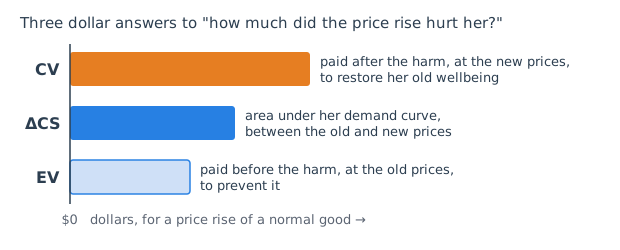
Courts rarely use any of the three cleanly. Antitrust damages are usually the overcharge on units actually bought, ignoring surplus lost on units no longer bought. Tort law’s “make the plaintiff whole” is closest to compensating variation. Today’s second problem puts both questions on the witness stand.
Problems of the Day
Q28: The Gate Fee
Festival lemonade is Thea’s weakness. Her reservation prices for the first five cups of the day are $10, $8, $6, $4, and $2: each is the most she would pay for that particular cup. Reservation prices are how economists define demand for discrete goods, which are goods that come in whole units only (1, 2, or 3 cups of lemonade instead of 1.32 liters). Read the list from the top and you have her demand curve: a staircase, not a line.
Inside the festival, cups of lemonade sell for $5. How many cups does Thea buy, and how much surplus does she walk away with?
Now the organizer, who somehow knows Thea’s numbers exactly, wants to charge her a fee at the gate. What is the largest fee she will grudgingly pay? What does your answer reveal about what the area between a demand curve and a price line actually measures?
Extension: Instead of a gate fee, the stand offers a single take-it-or-leave-it deal: “five cups for $X.” Find the largest X Thea accepts, and say what that number measures.
Q29: The Price of Water
Quarrytown’s only well belongs to Silas, and he has just quadrupled the price of water from $1 to $4 a jug. Greta, with income $100 and utility \(u = x_1 x_2\) over water (good 1) and everything else (good 2, $1 per unit), sues for damages.
Two economists testify. Greta’s expert asks: at the new price, how much money would make her exactly as well off as she was before? Silas’s expert asks: at the old price, what is the most Greta would have paid to prevent the increase? Compute both dollar figures. Then advise the judge: why do two honest economists disagree, which number answers which question, and is either of them wrong?
Extension: You’ve computed Greta’s CV and EV. Can you also compute the change to her consumer’s surplus as the change to the area under her demand curve and above the price? Like the introduction suggests, is it between her CV and her EV?
Answers
Q28: The Gate Fee. At $5 a cup Thea buys every cup whose reservation price is at least $5: the first three, worth $10, $8, and $6 to her. She stops there because the fourth cup is worth only $4 and would cost $5. Her surplus is the gap on each cup she buys, \((10 - 5) + (8 - 5) + (6 - 5) = 9\) dollars. In the staircase diagram this is the area of the three rectangles that sit above the $5 line and below the steps.
The largest gate fee she will pay is $9. Pay $9, walk in, buy three cups, and she is exactly where she would have been standing outside with her money in her pocket; pay anything more and she is worse off than if she had stayed home. So the area between the demand curve and the price line is not a vague “benefit from lemonade.” It is a precise dollar figure: the most she would pay for the right to buy at the going price. That is why a festival can sell admission at all, and why a price rise that shrinks this area is a loss that can be expressed in money.
Extension. If the only way to get lemonade is the five-cup bundle, Thea compares it with no lemonade at all. Five cups are worth \(10 + 8 + 6 + 4 + 2 = 30\) to her, so the largest X is $30. That is the entire area under her demand curve out to five cups, her gross willingness to pay, with nothing netted out. The gate fee measured the part of that area above the price line; the bundle captures the whole thing, including the cups she would never buy one at a time. (If cups were still sold at $5 beside the bundle, she would accept only when \(30 - X \geq 9\), so \(X \leq 21\): the bundle then has to beat her surplus from buying à la carte, not beat nothing.)
Q29: The Price of Water. With \(u = x_1 x_2\) Greta spends half her income on each good: \(x_1 = m/(2p_1)\) and \(x_2 = m/2 = 50\). Before the increase she buys \((50, 50)\), with \(u = 2500\). After it she buys \((12.5, 50)\), with \(u = 625\). A useful shortcut is her indirect utility, \(v(p_1, m) = m^2/(4p_1)\).
Greta’s expert wants the income \(m'\) that restores \(u = 2500\) at the new price: \(m'^2/16 = 2500\), so \(m' = 200\). The compensating variation is \(200 - 100 = \$100\). Silas’s expert wants the income \(m''\) at which Greta, facing the old price, would be exactly as badly off as she now is: \(m''^2/4 = 625\), so \(m'' = 50\). The equivalent variation is \(100 - 50 = \$50\). Greta’s expert says the harm is $100; Silas’s says $50.
Both are right. They disagree because they measure the same loss in utility with dollars that buy different things. The compensation in CV is handed over at the new prices, where water costs $4 and a dollar goes less far, so it takes many dollars to climb back to \(u = 2500\). The payment in EV is taken away at the old prices, where water is cheap and each dollar is worth more to her, so fewer dollars suffice to pull her down to \(u = 625\). Whenever the good is normal, a price rise gives CV \(>\) EV, and the gap closes only when her demand for water does not depend on income, which is the quasilinear case. The judge should pick the number that matches the legal question. If damages are meant to make the plaintiff whole, so that Greta, paying $4 a jug, is as well off as before, the answer is $100. If the question is what the price increase was worth to Greta before it happened, what she would have paid Silas to leave the price alone, the answer is $50. Neither expert is wrong; each has answered a different question, and the judge’s job is to say which question the law is asking.
Extension. Greta’s demand for water is \(x_1 = 50/p_1\). The change in consumer’s surplus is the area under this curve between the two prices, \[\Delta CS = \int_1^4 \frac{50}{p_1}\, dp_1 = 50 \ln 4 \approx 69.3.\] It lies between EV \(= 50\) and CV \(= 100\), as the figure in the key ideas promised. The demand curve is drawn holding income fixed at $100, so as the price climbs from $1 to $4 it tracks Greta getting poorer; it is neither the compensated demand that would give CV nor the one that would give EV, but something in between.